| Table of Contents |
|---|
| 1. What Is a Solar Inverter and Why Do You Need It? |
| 2. How Solar Inverters Work — A Simple Breakdown |
| 3. Types of Okaya Solar Inverters for Every Setup |
| 4. Frequently Asked Questions |
Solar power has become one of the most practical ways to reduce electricity costs and move towards clean energy. At the center of this shift is the solar inverter — the device that converts the energy your solar panels capture into electricity your home or business can actually use. If you're planning a solar installation or upgrading an existing one, understanding how a Solar Inverter works is the first step. Here's a breakdown of how solar inverters function, the different types available, and how to choose the right setup.
A solar inverter is the core component of any solar power system. It converts the DC (direct current) electricity produced by solar panels into AC (alternating current) electricity — the form used by household appliances and, in grid-connected setups, fed back into the electricity grid.
Without a solar inverter, the power your panels generate cannot be used by your home's wiring or appliances. Beyond conversion, Okaya's solar inverters add efficient performance, protection features, and — depending on the model — remote monitoring and backup support.
When sunlight hits your solar panels, it generates DC power. This DC electricity flows into the inverter, where it's converted into AC power. Depending on the type of system, that AC power is used instantly by your appliances, exported to the grid, or stored via a connected battery for later use.
Okaya solar inverters build on this basic process with a few intelligent features:
A. MPPT (Maximum Power Point Tracking) or PWM (Pulse Width Modulation) technology to optimize power generation across different sunlight conditions
B. True sine wave output for smooth, grid-like power suited to sensitive electronics
C. Smart RTC-based management to track and manage charging cycles
D. Dual charging from solar and grid in off-grid systems (select PWM models)
E. Auto-switching between solar and battery power depending on availability
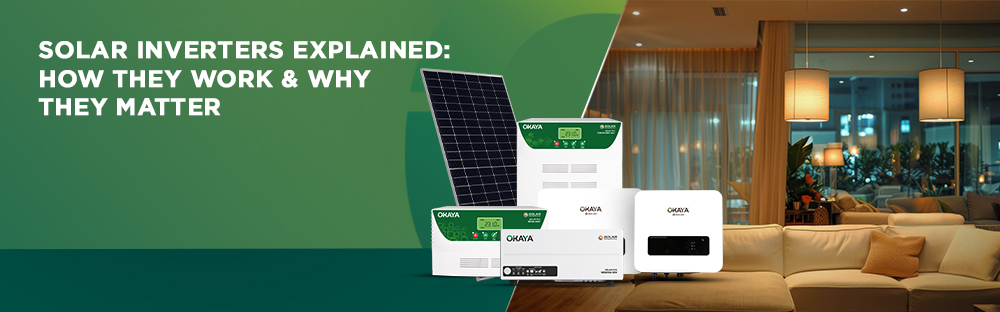
1. Okaya Off-Grid Solar PCUs
Built for locations with no or unreliable grid supply, off-grid systems work independently of the main grid and typically include a battery bank. Okaya's Solar Pcu range comes in two technologies: MPPT models (powered by DiM — Dual-Channel Interleaved MPPT — technology) deliver up to 98% efficiency and extract more energy even in low light or cloudy weather, while PWM models (with Twin Charge Technology for dual solar-and-grid charging) offer a more cost-effective entry point for smaller setups.
These PCUs also function as a Home UPS — prioritizing solar charging while keeping batteries topped up for backup when needed.
Available capacities: 925VA to 15kVA, with a uniform 36-month warranty across both PWM and MPPT models. Browse the full off-grid PCU range by VA rating.
2. Okaya Grid-Tied (On-Grid) Inverters
If your location has active grid supply and the goal is to reduce electricity bills, an Ongrid Solar Inverter is generally the better fit. On-grid systems let you consume solar power in real time and export any surplus to the grid — they don't provide backup during a grid outage, since there's no battery in the loop.
Okaya's current On-Grid range covers Single Phase models (3kW, 3.4kW, and 5kW) and Three Phase models (5kW, 8kW, 10kW, and 15kW), with up to 98% conversion efficiency and up to 120% DC input overload capacity across the range. Every model carries a 10-year (120-month) standard warranty and IP65-rated protection for outdoor installation.
A. Single-phase models offer RS485, USB, and Wi-Fi connectivity for app-based monitoring, with Dual MPPT on the 5kW model for installations with mixed roof orientations.
B. Three-phase models add Wi-Fi/GPRS/RS-485 monitoring, remote firmware upgrades, and string-level monitoring for faster diagnostics on larger systems, along with Type 2 SPD (surge protection) on both DC and AC sides.
Explore the full on-grid inverter range or buy solar inverter models on shop.okaya.in.
Supporting Okaya Components for Better Performance
A solar inverter performs best when it's paired with quality panels and batteries. Okaya covers all three:
A. Okaya Solar Panels — Available in Mono PERC Bifacial (up to 21.3% efficiency) and TOPCon Bifacial (up to 28.8% efficiency) technology, both with anti-reflective coating, MBB half-cut cell design, and positive power tolerance for consistent output, including in partial shade or diffused light. Available in both DCR and Non-DCR variants. See the full solar panel range.
B. Okaya Solar Battery — Built with Advanced Tubular Technology (ATT) for long backup and low maintenance. The AEMS (Advanced Electrolyte Management System), combined with Water Level Indicators (WLI) on each cell, helps maintain consistent electrolyte levels and makes fluid monitoring simpler. Warranty ranges from 36 to 60 months depending on the model. See the full solar battery range.
Why Solar Inverters Matter in the Long Run
A solar inverter isn't just a connector between panels and appliances — it's central to how much value you get from your solar investment. It helps to:
A. Convert and optimize solar power for real-time use
B. Reduce grid dependence and lower electricity bills
C. Store energy for later use in off-grid setups with a battery bank
D. Make the system trackable through app-based or remote monitoring (on select models)
E. Protect the system with built-in safeguards such as anti-islanding, over-voltage, and surge protection
Choosing the right solar inverter — matched to whether your setup is grid-connected or independent, and sized to your actual power needs — is what determines how much of your solar investment you actually get to use.
What makes Okaya solar inverters different from others in the market?
Okaya's solar inverters combine MPPT or PWM charging technology, true sine wave output, and BIS-certified build quality, engineered for Indian rooftop conditions across both off-grid and on-grid setups.
What is the difference between an on-grid and an off-grid solar inverter?
An on-grid (grid-tied) inverter works only while the grid is active — it lets you use solar power in real time and export any surplus, but has no battery and provides no backup during an outage. An off-grid inverter (PCU) works independently of the grid, typically with a battery bank, and can supply power even when there's no grid connection.
What is the difference between MPPT and PWM solar charging?
MPPT (Maximum Power Point Tracking) dynamically adjusts to extract the maximum possible energy from solar panels across changing sunlight conditions, making it more efficient — Okaya's MPPT PCUs reach up to 98% efficiency. PWM (Pulse Width Modulation) is a simpler, more affordable charging method suited to smaller, cost-conscious setups.
Can Okaya solar inverters be monitored remotely?
Yes. Okaya's on-grid inverters support app-based monitoring — single-phase models via RS485, USB, or Wi-Fi, and three-phase models via Wi-Fi, GPRS, or RS-485, with three-phase models also supporting remote firmware upgrades and string-level monitoring.
What warranty do Okaya solar inverters carry?
Okaya's Off-Grid Solar PCUs (both PWM and MPPT) carry a 36-month warranty. On-Grid (Grid-Tied) Inverters carry a longer 10-year (120-month) standard warranty across the full range.
Is Okaya's solar inverter range suitable for both homes and businesses?
Yes. Okaya's range spans 925VA off-grid PCUs suited to small homes, up to 15kW on-grid inverters suited to larger residential, commercial, and light industrial rooftop installations.
What type of battery is recommended for Okaya off-grid inverters?
Okaya recommends its Solar Tubular Batteries, built with Advanced Tubular Technology (ATT) for deep-cycle performance and long backup, designed to pair with off-grid PCU setups.
Can Okaya solar solutions work in areas with frequent power cuts?
Yes. Okaya's Off-Grid Solar PCUs are designed to function independently of grid supply, automatically prioritizing solar charging and switching to battery backup, making them suited to areas with unreliable grid supply.
 OKAYA POWER PVT. LTD.
ENERGIS D-7, 3rd & 4th Floor, Rohtak Rd,
Udyog Nagar, Mangolpuri,
New Delhi - 110041, INDIA
© 2026 All Rights Reserved to Okaya Power Private Limited